Mourning the end of an era, and #NotEnough4ME

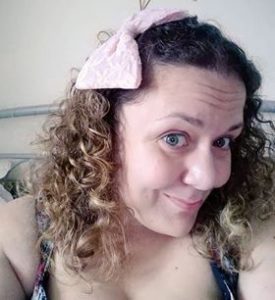
Three photos of a white female with dark hair; first, labeled My first real job, 1987, is in black and white. I'm wearing a sweater and sitting at a typewriter. Second, I'm wearing a purple suit in a professional photo, labeled middle-of-career, 2001. Third, a selfie with my face and some art behind me, labeled my last real job, Aug. 14, 2014Five years ago yesterday was the last day of my last job, the end of my professional life, and the start of my life as a disabled person (although I didn’t know at the time that it was the end, and it took me a long time to call myself disabled).

My last full-time, professional job (as opposed to the random jobs, like pet-sitting, that I had been doing to make some money), I had been teaching at a large university in my state, and the third semester “broke me”.

My recollection is fuzzy on how I felt and what I did, but I can tell you definitively that I knew I had no choice but to quit. And it hurt to admit that, and it hurt to actually resign. I loved teaching. I loved my students. I loved sharing what I had experienced during my 20+ year marketing career to people who wanted to learn.

But my health said ‘nope’.

By October, two months after the school year had started, I knew I could not continue. I resigned so the college could find a replacement for my spring classes, but I finished the semester anyway – I was NOT gonna leave my 150 or so students in a lurch, or cause hardship for some new instructor.

December 14, 2014, five years ago, I was done. I’d turned in grades to the school and uploaded grades and feedback to the online learning management system for my students.

And… I collapsed. I became a full-time Sick Person. (I tried to do some things; but ultimately they just made me worse.)

Black type on pink background: It never occurred to me that one day I'd wake up sick and never get better.

So today, I mourn the end of an era of my life – the end of my career, and my identity as a working person.

I thought it was going to be temporary. I thought I’d figure out what was wrong with me, and get back to work. But that didn’t happen.

Losing my identity around my career has been difficult. After all, I’ve been paying my own way since I was 14, and my first on-the-record job was in 1987, typing up pledge cards – on a typewriter – for the United Way of Palm Beach County (photo above, on the left). I thought by now I’d be the Executive Director of a non-profit, or the VP of marketing for a big company, but nope. I’m a stay-at-home, full-time Disabled Sick Person.

No one tells you that there are diseases that doctors can’t identify or treat. Everyone knows about “fighting cancer”, or having an easily-seen physical disability, but no one seems to acknowledge this middle place of invisible illness, of a disability that will never go away.

And of course there’s the rhetoric that your worth is based on what you produce.

Which is not true.

It took me a long time to see that.

And even though it’s been five years, sometimes I don’t think I’m really that sick, until I go to a doctor’s appointment, and am paralyzed and cannot move when I get home, and my husband has to literally drag me out of the car and carry me to the bathroom and bed. (True story; it happened Wed, Dec 4.)

And when I get upset when a new symptom appears, or something gets worse, I feel like perhaps I’m not being grateful enough for the fact that my disease is not far more debilitating.

I’m mourning, but I’m also somehow moving on, tolerating the fact that I’m sick, accepting that I am enough, and using what little energy I have to advocate and share my struggles so that others know they are not alone.

And for 2020? I hope to continue posting a blog on the 15th of every month, as I’ve done this year (with a few exceptions where I posted late), and continue to write in my Gratitude Journal [affiliate link] every single day (which I’ve managed every day this year but one, where I fell asleep and forgot).

There’s more I want to say, but it’s 9:27pm on Sunday, December 15, and I’m very very tired and the nerves in my back are on fire and my head is pounding, so I guess I’ll just leave this post be. It, like I am, is perfect as it is.


Black, white and red image with the hashtag #NotEnough4ME and the #MEAction logo. Includes a black and white photo of Dr. Walter Koroshetz of the NIH.

If you’ve read my blog at all, you know that part of my raison d’être is shining a light into the dark places in our world, so that we can acknowledge and stop them, something I’ve been trying to do since I started this blog.

I’m also a patient with moderate-severe Myalgic Encephalomyelitis (MEcfs), a nuero-immune disease with no known cause, no treatment, and no cure.

I’ve only had MEcfs full-time for the past five years (tho I’m certain I had it at least three years before I “broke”; I just didn’t realize I was sick, in what is known as ‘gradual onset’) – but there are people who have been sick for decades, such as advocate Wilhelmina Jenkins, who fell ill in 1983.

And in all that time, very little has been done to help #pwME (patients with ME); in fact, mostly the disease and its sufferers have been derided and ignored.

That’s where #MEAction comes in – doing advocacy to try to get “recognition, education, and research” for MEcfs.

The latest collective action from #MEAction is a campaign called #NotEnough4ME, targeting Dr. Walter Koroshetz, Director of the National Institute of Neurological Disorders and Stroke (NINDS). Simply put, Dr. Koroshetz is the single-most influential person at the National Institutes of Health (NIH) who stands in the way of a bigger, bolder, faster response to the ME crisis.

#MEAction sent him a letter regarding the NANDS Council Working Group report on ME/CFS research (60-page PDF; dated September 4, 2019), outlining a list of demands (PDF; dated October 22, 2019) for #pwME.

Unfortunately, Dr. Koroshetz’s response (PDF; dated November 4, 2019) was, well, #NotEnough4ME: “He did not agree to any of our demands. He repeats the list of insufficient activities NIH had previously announced and recycles the same empty bureaucratic excuses that NIH has been giving us for decades. We can’t let this stand. We know the actions that NIH needs to take to end this crisis and save lives. Koroshetz’ “plan” for ME, and his response to our demands, are NOT ENOUGH.”

On Monday, November 18th, as part of a community virtual action, lots of people in the community posted videos (which you can view on youtube) with the message that the NIH is failing us, and a request for people to Sign the Petition requesting more funding and research.

This is my video, which I almost didn’t do because I felt so terrible, and I didn’t have my voice:

(And I wanted to delete the last second, because it’s too heartbreaking, but I couldn’t figure out how to do it.)

I am so honored by all the responses to and shares of my video, which I posted on twitter and Facebook.

However, it both saddens and angers me that so few people (under 7,000!) have signed the #MEAction petition. I saw a petition where some town in England is upset over new decorations in the town square – signed by over 10,000 people! Why and HOW are decorations more important than the lives of those of us who live daily with this horrible disease!? Please take a just a moment to add your name to the petition!

Another Way to Help

This holiday season, send Dr. Koroshetz a card asking him to take immediate ACTION to end the crisis of Myalgic Encephalomyelitis (ME) after 30 years of neglect.

Follow these easy steps to participate! Let him know he is not doing enough to fund and accelerate ME research. Our community deserves URGENT ACTION. Like Sarah, here, a bed-bound MEep who has posted and sent her card:

(Note: much of the language in this part of the post is taken from #MEAction’s campaign page.)


PS: If you enjoyed or appreciated what you read, and aren’t currently a subscriber, then please follow my blog! Simply enter your email address in the box under “Follow dSavannah Rambles” that’s on top of the right-hand column. (Or, if on mobile, scroll aaallll the way down to the bottom of the page and enter your email address in the subscribe box.) Thanks!

Before you go:

I’ve never had ads on my blog, and never wanted them, but it’s expensive to have a website, what with the domain registration & hosting fees. And I haven’t been able to work in exactly five years, and I get no disability benefits – and my medications and supplements alone cost me more than $300 a month!

If you found this post useful or inspiring, please consider supporting me and my ramblings:

Your support keeps me going, even in tough times. Thank you for stopping by my blog.

THANK YOU! to a friend from college who surprised me by sending me three Terry Pratchett books [affiliate link] off my wishlist! (only my Very Favorite Author).

And a big THANK YOU! to everyone who donated in the past month to the organizations who are fighting so hard for #MEcfs research: the Open Medicine Foundation, SolveMECFSInitiative, and #MEActionNet, an organization that focuses on advocacy. Donate online with a credit card, giftcard, or paypal!

Also note: through December 31, all gifts to SolveMECFSInitiative will be TRIPLE MATCHED!

Posted in #dSavannahDefects, advocacy, chronicillness, community, disability, giving to others, hard work, illness, inspiration, learning, making a difference, passion, perseverance, shining a light, the dark places | 14 Comments

Giving, GERD, and Genes (oh my)

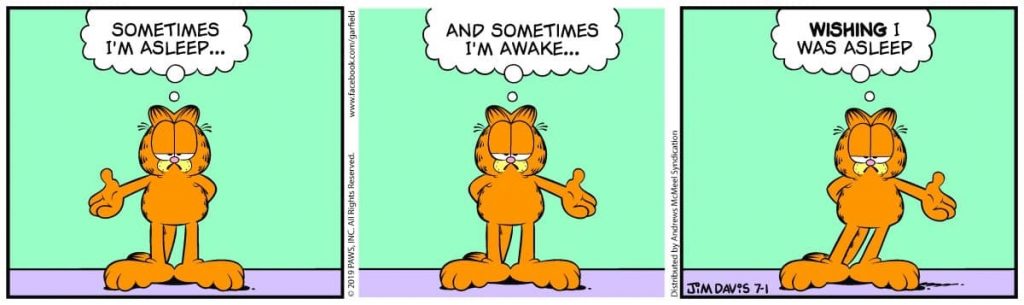
Garfield comic strip. He says Sometimes I'm asleep... sometimes I'm awake... wishing I was asleep.Hello my friends. It’s November, and I continue to be waylaid from writing my monthly post by other, very stressful things in life. And the weather. Storms and colder temps increase my symptoms and make me feel worse, so, well, I have felt extra crap. I currently have a very horrible headache at the top of my neck / the base of my skull, one that started yesterday and won’t go away. I would really like to chop my head off, it hurts so bad… And my eyes are so dry, they feel like little cinders. And yes, I would prefer to be asleep. Garfield gets me.

Thus, instead of trying to put together a coherent, long-form piece, I decided I’d share a bunch of random thoughts I’ve been having…. which has turned out to be more than just the three topics in my headline. (However, the alliteration amuses me, so I’m leaving it.)

The day before yesterday was the 15th, the day I was supposed to publish, but obviously did not. I worked on this post yesterday, but my head pounded too much for me to trust myself enough to publish. And it didn’t happen on my regular day, thanks to being in a crash for four out of the previous six days, with one of those non-crash days spent at doctors’ appointments. (A “crash day” is one where I can’t do anything at all; I’m just so ill, I’m stuck in bed. If I’m lucky, I’m asleep for part of that day.)

dot

This holiday season, support local and independent artists, designers, and crafters.

Sorry, I don’t know who originally created this image, tho I tried to find the source. However, I do hope my readers will shop indie!

Since it’s November, that means it’s the start of ye ole holiday season. In the past, I’ve published a couple gift guides, but I’m too tired to do so this year (and I’m too tired to update the gift guides I’ve already got).

So, here’s a couple from bloggers I follow, with some great ideas:

dot

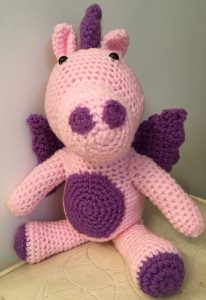
Crocheted dragon. Main body is pink, with dark purple accents - nose, belly, wings, and spines.

My dragon, hand-made by Carol. Alice named her Tamsin Peony (at my request for a name).

If you’ve read my blog for the last few months, you’ll remember that I’ve been asking people to donate to my friend Alice to help her with expenses for a power wheelchair. (You can read about her in her guest post.) In addition to asking for donations, she has worked very hard to raise some funds herself, including car boot sales (flea markets, for those of us in US), and bingo. (I can’t remember what all.)

To help out, Alice’s ‘internet mum’ Carol is offering a gift to anyone who donates at least £20 to Alice via her gofundme or her paypal – she will hand-crochet you your very own dragon. Mine arrived a couple weekends ago, and I lurrrrveeee her!!!!

dot


In this season of giving, there are two great deals going on right now to double or triple your contribution to ME/CFS research:

  • Open Medicine Foundation Triple Giving Tuesday – from October 22 all the way until December 3, OMF will TRIPLE your contribution to ME/CFS research, thanks to several generous donors who offered to match donations up to $666,666! The name refers to the annual tradition of Giving Tuesday, December 3 this year, the day after Cyber Monday, but donations will be tripled EVERY day between now and then. Just click the link to make your donation. It doesn’t have to be a lot – every little bit helps, especially when it is tripled!
  • Solve ME/CFS Initiative Double-Your-Impact Challenge – thanks to several anonymous donors, any donation you make to Solve ME/CFS from now until December 31 will be doubled, up to $750,000! They are hoping to meet a goal of $1.5 million in total donations by the end of the year. Just think of all the great research that can be done with that money!

These are two outstanding opportunities to make your money go further and give a gift that will help all of us this holiday season! Click the links to donate TODAY, watch your donation get doubled or tripled, and contribute to important ME/CFS research. You can even share the links with family and friends and tell them that THIS is what you want for your holiday gift.

Almost all of the amazing research breakthroughs in ME/CFS in recent years have come from private donations (and much of it from these two excellent organizations), so this is a great way to keep the science moving forward…for a happier New Year for all of us!

Happy Holidays and Happy Giving!

dSavannah note: a HUGE thanks to the blog Living With ME/CFS for giving me permission to use the above wording (starting with “In this season of giving”) from their most recent post! Saves me a bit of brain power. Be sure to visit their blog! (You can also find them on Facebook.)

dot

Y’all my voice is gone again. You may remember (or don’t remember, if you have brain fog; or have no idea, if you’re just visiting for the first time), that I first lost my voice on May 11 of this year, after crashing from doing advocacy for the #MillionsMissing awareness campaign for Myalgic Encephalomyelitis (MEcfs). After my voice was gone for 26 days, I saw an ENT who told my that the GERD (acid reflux) I had corrected via Nissen Fundoplication surgery in 2010 is back.

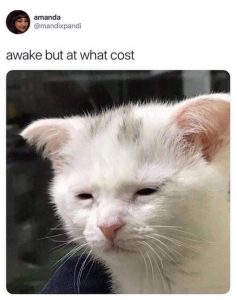
Photo of a white cat wtih its eyes almost closed. Caption says awake but at what cost.

I don’t have a good image for this section, so this funny meme that goes along with my header comic will have to do.

I had a test with a tube up my nose and down my throat for 24 hours – it measured the pH in my esophagus, which proves, without a doubt, that the GERD is back, and is moderate-severe. Oh boy. Without that test, I would have sworn my GERD was gone for good – I’ve had NONE of the symptoms I had before surgery. But the acid inflamed my esophagus, and my vocal cords, and my false vocal cords, and voila – voice go bye bye.

So back on acid reducer medication for me…

(Aside: Nissen basically takes part of your stomach and folds it around the esophagus to create a ‘wrap’ that then mimics what the sphincter at the top of your stomach is supposed to do – not let food and acid up into your esophagus.

I had an endoscopy and colonoscopy in 2015. The gastroenterologist who did it said there was nothing wrong, and to come back in 10 years. I got a hold of my medical records, and the report from the person who actually read those results stated that I have: gastritis, hiatal hernia, moderately loose Nissen wrap, localized mild inflammation characterized by erythema in the gastric antrum, and esophagitis. In short: I should have been treated for this FOUR YEARS AGO.)

My voice finally came back after 63 days. Then I’d lose it again for a few days, and it would come back. Then I had a phone conversation and lost it for 2 weeks. Then it would come back. I had a phone conversation on Oct 24, and guess what? It’s gone again. Today is day 23.

Obviously, I cannot speak to those who live with being deaf, mute, and/or hard of hearing all the time based on what little I’ve experienced, but I can tell you one thing: the world is not set up for someone who cannot talk. Especially not a person who is a full-time chronic illness patient and their job basically involves talking to doctors and insurance. On the phone. (I managed to return a couple calls to doctors on Wednesday, but that means my voice is completely gone again.)

dot

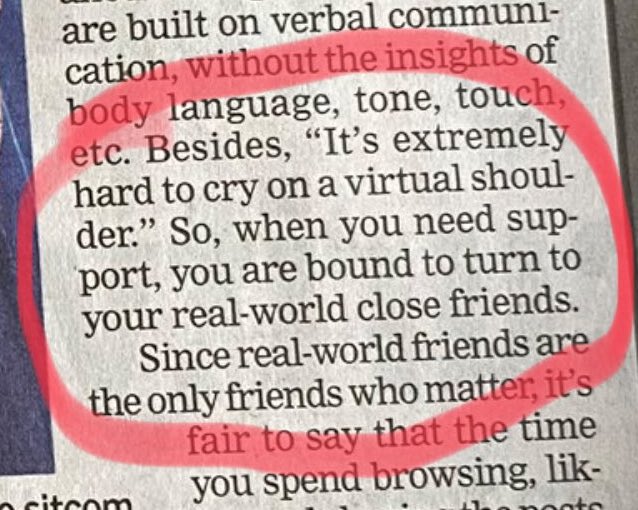
In what can only be called FAKE NEWS (for realz), a recent article posted in the Times of India has the headline “Why Social Media Friends Don’t Count”.

I was first alerted to this on Twitter by Erin Gilmer, esq., a disability attorney, who shared the original tweet:

My reaction? and the reaction of many many other people who have found amazing friendships online? A giant eye roll. I think I managed to see the 1980s. (Never mind. It’s just that the fashion is coming back. And all I can say to that is WHY??!? WHYYYYYY!??!?)

For me, and many others, social media is a lifeline. I have learned so much about my conditions from being able to talk to other patients. I’ve gotten support when I’ve been having a bad day. I’ve been able to support others when they are down. There are people I call my friends, and my family, who I’ve never met in person, and probably never will.

I especially found this statement heinous and patently untrue:

Text from newspaper with red circle around it. It says: Besides, it's extremely difficult to cry on a virtual shoulder. So, when you are in need of support, you are bound to turn to your real-world close friends. Since real-world friends are the only ones who matter"

Believe me, I have cried many a time on a virtual shoulder, and my virtual shoulder has been cried upon too. Just because I can’t see the tears, doesn’t mean they are any less real. Oh, yeah, and most of my “real-world” friends disappeared when I got sick, as I talked about in my post F is for … friendship.

I also had to laugh at this response, cuz yeah – my penpals were also my friends! (and it wasn’t all that long ago when we communicated solely via the mail!):

Oh, and for the record, Alice is a social media friend who I’ll probably never meet in person, but she is quite dear and special to me.

So, for those of you “imaginary friends” in my life – THANK YOU! for being my friend. I wouldn’t make it without you.

dot

I had a comment on my post what a pain from someone saying they were now interested in having their genetic testing done. As I responded to them, I had my DNA tested by a medical testing company, ©DOCTOR’S DATA, INC., and it was ordered by my physician.

There is some benefit to doing the 23andme test and then submitting it to Genetic Genie, which can take the data from 23andme and then run a free methylation and/or detoxification profile. Both of these provide a lot more info than the test I had. I’ve been considering having that done as well. (And the full kit – 23andMe DNA Test – Health + Ancestry Personal Genetic Service – includes 125+ reports on Health, Wellness, Ancestry & More [affiliate link] – is currently on sale on Amazon, and if you have Prime, then free shipping.)

I feel the more info you know about your body’s processes, the better, and it can help you figure out the best way to treat your health issues. (Instead of blindly stabbing in the dark, like I did for so long.)

dot

If you’re a chronic illness patient, and have to take lots of meds, like I do, you probably have trouble remembering what to take when. A doctor I saw a few years ago who was otherwise a, erm, not-pleasant person, suggested that I create a spreadsheet to keep track. So I did.

Well, it’s actually a word document with boxes. Since I’m a giving person, I created a blank(ish) document that you can download and personalize for your own needs. Download the file ‘meds_schedule_template’ from dropbox (created in word, but works in google docs as well. You don’t need a dropbox account to download it). I wouldn’t know what meds to take when without mine.

I use one document per week, and when I print it out, I just write the date on top. It’s divided into columns for the time of day: anytime, morning, midday, night before bed, and right before bed. (Of course, you can change those categories to whatever works best for you and when you need to take your meds.) I cross off the letter for the day of the week as I take each pill. I’ve also started scribbling the time at the top of each column, since some medications have to be taken on a very rigid schedule.

I hope this helps someone!

dot

PS: If you enjoyed what you read, and aren’t currently a subscriber, then please follow my blog! Simply enter your email address in the box under “Follow dSavannah Rambles” that’s on top of the right-hand column. (Or, if on mobile, scroll aaallll the way down to the bottom of the page and enter your email address in the subscribe box.) Thanks!


Before you go:

I’ve never had ads on my blog, and never wanted them, but it’s expensive to have a website, what with the domain registration & hosting fees. And I haven’t been able to work in almost five years, and I get no disability benefits – and my medications and supplements alone cost me more than $300 a month!

If you found this post useful or inspiring, please consider supporting me and my ramblings:

A giant THANK YOU! to the person who sent me four! items off my wishlist this past month! The amazing thing is that I don’t know this person, and I can’t figure out how they might have found me or how we’re connected. I am truly grateful for this person, and everyone who sends me anything.

This support keeps me going, even in tough times.

Posted in #dSavannahDefects, advocacy, art, chronicillness, community, friends, giving to others, health, illness, making a difference | 4 Comments

#dSavannahDefects – a photo journey

Hello dear peoples, well once again I have no words and no time to write them, nor the energy, so for this here October blog post, I am instead going to use the theme I used for the #AtoZChallenge in 2016#dSavannahDefects – but instead of telling you about more about my illnesses, I shall defect to some photos, most of which I took back when I was a healthy.

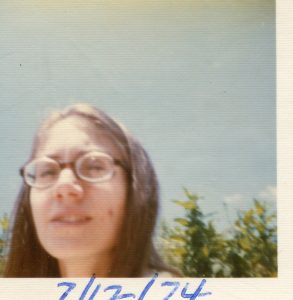
I’ve always loved taking photos. In fact, I took my first photo when I was just three years old. I couldn’t tell you what kind of camera it was, but I can show you the photo:

My mom!

Not the best job framing the subject, but hey, I was three!

Also, in a happy coincidence, today (October 15) is her birthday! HAPPY BIRTHDAY, MOM!

Obviously, I was shooting photos on film, long before digital was even a whisper. For you whippersnappers, you’d get 24 photos on a roll of film, and once you’d taken all the photos, with nary an idea of what you’d gotten, you’d have to take the film canister to a photo lab and have them developed. And wait. Or pay a lot of extra money to get them developed in one hour.

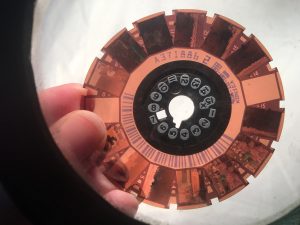
In high school, I had the coolest camera – a Kodak disc camera. (A girl from my youth group borrowed it and never gave it back.)

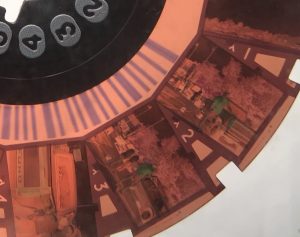
One of my disc film negatives, as seen through my magnifier. I have no idea the exact date; just know it’s late 1980s.

Based on this close-up, at least some of the photos are of a car wash my youth group did.

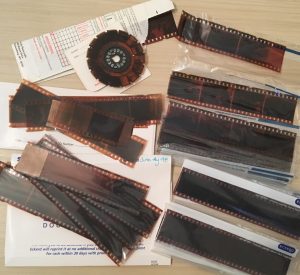
Here are some negatives; and yes, I have a whole bunch more than this small pile, and many of them are not labeled:

No idea what most of these are!

I have a scanner that has an attachment so you can scan film negatives, but unfortunately, I can’t remember where I put it. UGH this brain fog! (Shocking, really, that I remembered where I’d stashed those negatives.)

I used my magnifier to take this photo of one of the negative strips. I’m on the left, and my kitty Ashley is on the right. (Sometime in the mid 1990s)

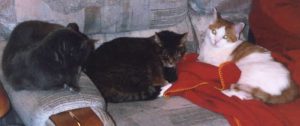
Fortunately, I scanned some of those film photos. Even back then, lots of photos were taken of pets.

My kitties long ago – Ashley, Ali, and Lucas. (Yes, I paid money to have that photo developed! And obviously I cropped it when I scanned it in.)

And of course, you’d take photos on vacation, carefully rationing out what you shot so you’d not run out of film.

Near Moab, UT, on vacation in 1999. If you squint, you can see the date printed on the bottom right corner. What a great invention that was!

I can’t remember my first digital camera, but like so many things, I was an “early adopter”. (Apparently, it was an Olympus, as I discovered whilst looking through some photos on my computer.)

One of my best birthday presents was from my husband, who got me a Nikon D60 in 2009. I love(d) having a real camera!

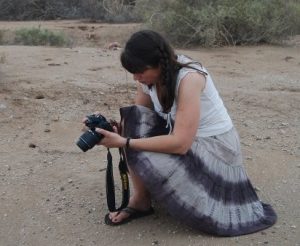
I did this a lot. Crouch down and take photos of something odd and typically overlooked. (Me in Arizona, September 2009. Photo by hubs.)

But taking photos was more than just a hobby. You could say I was a semi-professional! People asked me to shoot their family pictures:

A sweet pic of a mama holding her baby’s hand, and a rare instance of where I played around with coloring. Usually my shots are #SOOC – straight out of camera – with minor editing / cropping. (Oct 2012)

Charlie in front of his family’s Christmas tree for their holiday card. (Dec 2013)

I also had photos in group shows and exhibitions put on by the Harrison Arts League and the Photography Club of the Ozarks (when I lived in Arkansas and belonged to both organizations).

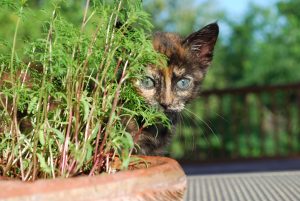
Most excitingly, in November 2009, this photo of my kitten Cricket was one of 40 photos selected to be in the  33rd Annual Photography Competition and Exhibition, a juried show, at the Fort Smith Arts Center, in Fort Smith, Arkansas.

I called this “Kitten in the Cosmos”.

I was also so pleased when I had a solo exhibition of 35 of my original photographs in October 2011: “Small Dreams, Whimsical Realities”, at the Oak Leaf Gallery, part of the Ozark Arts Council in Arkansas. (You can see me on the local TV station, Hometown Television, on the show 726, talking about my exhibit – thanks to them sharing it on youtube.)

I always liked taking shots from odd angles, like this rose in front of the Arkansas State Capitol. (May 2011)

The Sidney Lanier Bridge in Brunswick, Georgia. (July 2011)

I called this “Cool Old Thing”. Part of some machinery somewhere in a barn or old building in Arkansas. (Sept 2010)

My dear Grandmother was somewhat bewildered at all the photos I took. “What are you going to do with them?” she asked me a number of years ago. Of course, taking the photo and then editing it later was joy enough, without having to “do” anything at all with it.

A flower I took on the grounds at my Grandmother’s home. (September 2010)

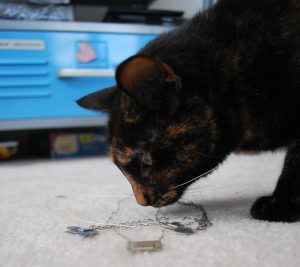
A grown-up Cricket in 2013, checking out some of my necklaces.

Have you figured out I love shooting flowers? (February 2017)

Sadly, it hurts to hold my camera these days, much less crouch down or focus or any of the other things I used to do to get a shot. Thankfully, although I have trouble holding my Nikon, my iPhone 6 has a pretty decent camera, and I’m able to get some decent photos using it:

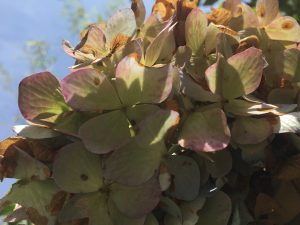
Hydrangeas I shot with my iPhone, whilst sitting in my rollator, during a rare outing to look at flowers – #SOOC (Aug 2019)

Of course, many of the photos I take with my iPhone are of my pets, whilst I am in bed, like these:

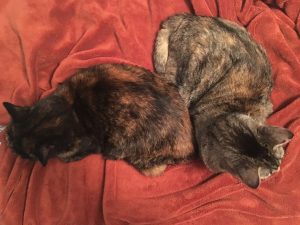
Cricket (left) and Piper (right) snuggling. (June 2018)

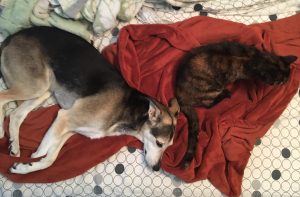
Maggie (left) and Cricket (right). (July 2018)

Piper snuggling on my lap whilst I’m in bed. (Oct 2019)

Someday, I’ll hopefully be able to pick up my real camera and do “real” photography again, including editing and printing. And yes, I grieve the loss of that ability and everything that goes along with it. There are babies and weddings and funky things I should have shot, but couldn’t! So for now, I try to be grateful for a phone with camera capabilities, something that didn’t exist a mere 20 years ago.

I hope you enjoyed this defect from my usual dSavannah in all my defective gloryramblings about chronic illness. And I hope you remember that there is beauty to be found, even where you’d least expect it.

PS: If you enjoyed what you read, and aren’t currently a subscriber, then please follow my blog! Simply enter your email address in the box under “Follow dSavannah Rambles” that’s on top of the right-hand column. (Or, if on mobile, scroll aaallll the way down to the bottom of the page and enter your email address in the subscribe box.) Thanks!


Before you go:

My dear friend Alice, who I featured in July’s post, #MEcfs Awareness: Guest Post “Send My Apologies”, has gotten her wheelchair! Hooray! Unfortunately, she didn’t raise enough funds to purchase it outright, so had to finance part of the cost. If you can, please consider donating to her gofundme so she won’t have to pay too much interest. She also needs money for insurance and accessories – some of which you can send her from her Amazon wishlist. Anything you can do is much appreciated!

In other news for me, a website, Pain Resource, put out a call for someone to review a TENS Machine. I sent them the link to my profile on amazon, where my reviewer ranking is 4,571!, and they asked me to write the review! Hop over and check out what I wrote about the Easy@Home Heat TENS Unit.

I’ve never had ads on my blog, and never wanted them, but it’s expensive to have a website, what with the domain registration & hosting fees. And I haven’t been able to work in almost five years, and I get no disability benefits – and my medications and supplements alone cost me more than $300 a month!

If you found this post interesting, useful, or inspiring, please consider supporting me and my ramblings:

Your support keeps me going, even in tough times. Thank you for stopping by my blog.

Also, if you would like to help terribly ill #MEcfs patients like me, please consider donating to the Open Medicine Foundation or SolveMECFSInitiative, both of whom focus on research and looking for a cure; or #MEActionNet, an organization that focuses on advocacy. Donate online with a credit card, giftcard, or paypal!

Posted in #dSavannahDefects, art, artist, happiness, inspiration, photography | 5 Comments

what a pain…

dSavannah note: Hello, dear readers and people who have stumbled across this blog by accident. This is my post for September 2019, which as I promised back in ye olden days of January, is being published on the 15th 16th. Yup, this post is late.
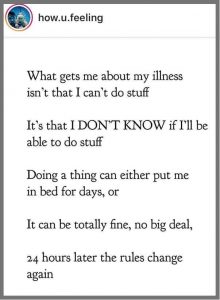
Screenshot of post by how.you.feeling. What gets me about my illness isn't that I can't do stuff. It's that I DON'T KNOW if I'll be able to do stuff. Doing a thing can either put me in bed for days, or it can be totally fine, no big deal, 24 hours later the rules change again. Also, this post is a bit different. You see, typically, I have an idea, and I write a few words here and there over a long period of time. (For instance, I’ve already written some for December’s blog post.)

I’ve had my topic for a couple months, but… when I’ve had a moment when I could focus on my blog, nothing has come to me. Not one word. I’d open my laptop to work on the post, and… my mind would go blank. And the rest of the time, I’d have to focus on other things going on in my life right now which take priority over my blog. Or, I’d be completely crashed in bed, unable to do anything at all, which accounts for 15 of the days since my last post. I also had seven doctors’ appointments, and when I have to see a doctor, that’s all I can do that day, which leaves me with very little usable hours for my blog. All that means: I basically wrote the vast majority of this post in three days, which I never ever do anymore. I can’t. It’s too hard on my body.

This post is also different, because I was chosen by an app, called Pathways, to write about pain and their app, which is supposed to help people with chronic pain. (Their tagline: “Created by pain patients. Backed by decades of pain science”.)

In fact, Pathways gifted me access to the app for one year in exchange for featuring on my site. Which hooray! They like my reviews and how I write, but Oh geez. What if I don’t do it well or right? Typically, I’ve worked best under pressure (like my whole career), but for some reason (probably the other giant stressors in my life right now) (which I can’t really talk about, but which had to take priority), my brain just ain’t working right. But we’ll soldier on (please forgive me for use of cliché!), and please forgive me if this ain’t the best post you’ve ever read.

And to my fellow #MEeps and other chronic illness patients who have trouble reading, my voice is gone again, so I can’t record this post (or the other ones I haven’t recorded yet). When I get my voice back, if I use it “too much” (tho who knows how to quantify that!), it goes away again. Even with speech therapy sessions and doing my speech therapy exercises and taking my GERD medication.

And to those of you who are reading this: somehow this has turned into what is probably the longest blog post I’ve ever written. Sorry! Feel free to read a section at a time and come back to it. Also, if you see any wacky typos, please please let me know so I can fix them!


Before we get to the important part of my post, which is about pain and ways to cope with it, and my thoughts on the Pathway app, I have to share:

In my January post, not only did I say I planned to publish a blog post every month on the 15th, I also said “I’m going to consciously practice gratitude.” And to do that, “my goal this year is to write in [my gratitude journal] every single day, right before I go to bed.”

Image of orange and white book with orange ribbon bookmark. Dates on left side of book are June 1, 2014 - Jan 20, 2018; dates on right side are Jan 1, 2019 - Sept 7, 2019. Bottom type says: dSavannah’s 2019 Gratitude Journal.

And guess what? I did it! Some days, it was really hard to come up with anything at all. And some days, I needed more than one page to list things I was grateful for. But I managed to write every.single.day this year.

I used the last page in my Gratitude Journal on September 7, 2019, at exactly 250 days of practicing gratitude. YAY ME! (For the rest of the year, I’m using a mini Moleskin notebook someone gave me a long time ago. I’m hoping someone will gift me another Gratitude Journal from my Amazon wishlist for 2020.) (For which I will be very grateful!)

So, here we go, on to the post:


Living with Pain

I live with pain. I wake up in pain, I go to bed in pain. My day is spent in pain. It never ever ever ends. Sometimes it eases up, and sometimes it’s excruciating, but it’s never not there.

Health Conditions

My pain is caused by a number of debilitating, chronic conditions. The biggest culprits are Myalgic Encephalomyelitis (MEcfs), fibromyalgia, and hypermobility syndrome, which is a subset of Ehlers-Danlos Syndrome, a group of connective tissue disorders.

I also have a myriad of spinal issues, including osteo arthritis, spondylosis, disc compression and degeneration, scoliosis, stenosis, and nerve damage. My neck/shoulders and lower back are often screaming at me! (And those aren’t the only things I have that cause me pain, but this post is probably already long enough!)

Everyone experiences pain a bit differently, even if they have the same condition. As the CDC says on their page about MEcfs and its symptoms, “Pain is very common in people with ME/CFS. The type of pain, where it occurs, and how bad it is varies a lot. The pain people with ME/CFS feel is not caused by an injury. The most common types of pain in ME/CFS are:

  • “Muscle pain and aches
  • “Joint pain without swelling or redness
  • “Headaches, either new or worsening”

Check, check, check. Yup, got those all.

The Mayo Clinic’s page on fibromyalgia says: “Fibromyalgia is a disorder characterized by widespread musculoskeletal pain accompanied by fatigue, sleep, memory and mood issues.” (And lucky me: a rheumatologist said I’m in the top 1% of worst fibro cases.)

Genetics

Stylized image of a gene sequence with a pair of scissors cutting a bit out.

Gene snipping icon made by dDara from www.flaticon.com

In addition to all of that (as if it isn’t enough!), I have homozygous (+/+) / double mutations in two of my genes: COMT V158M and COMT H62H.

I know this information, thanks to a DNA test called “DNA Methylation Pathway Profile“, which I had done in 2015 when I was first trying to figure out what was wrong with me. (Many of you donated to my gofundme campaign that helped me pay for it, for which I am forever grateful.) I have a total of eleven genetic mutations out of the 30 genes tested, three of which are double mutations.

According to my genetic report, the COMT genes in particular are “found in nerve cells, and in the liver, kidneys and red blood cells. In the brain, COMT functions to break down catecholamine neurotransmitters such as dopamine, epinephrine, and norepinephrine.”

They say that the possible health implications of these genes being mutated “may affect neurologic processes (particularly prefrontal processing), including mood and pain tolerance”, and one mutation in particular “is associated with deviations in thought processes”. In addition, “There is a decrease in enzyme function” … “with up to a four-fold decrease in enzyme function” for one of my mutations!

To summarize all that in laymanspeak, and as my doctor explained it to me, I feel more pain and anxiety than other people, specifically because my genetic makeup is written that way. An article I found while researching this blog – “A pack of smart, hedonistic creative types with a lot of anxiety and high brain dopamine: A case history of a family homozygous for the COMT Val158Met mutation.” – really made me think, because it sounds soooo much like me!

Thus, when you add in my fibromyalgia, which, according to the Mayo Clinic – “Researchers believe that fibromyalgia amplifies painful sensations by affecting the way your brain processes pain signals.” – I’m just a hot mess!

(If you want to learn more about genes and whatnot, explained much better than I can, check out this article Heterozygous vs. Homozygous Differences on the site VeryWellHealth. An article specifically about the COMT Gene, Worriers and Warriors, on the website for the company Advanced Genomic Solutions (AGS) Ltd., explains it even more specifically. [Note: they also offer genetic testing, but I have no experience with them.])


Dealing with Pain

Image with words associated with pain on it, such as pressing, tender, cramping, aching, and dull. The word pain is the largest.Now, obviously, there is not one thing I or anyone else can do about my genetics. There is no procedure to go into my genes and un-mutate them.

However, knowing about them helps me understand what is going on with my body. As the The Great Plains Laboratory, Inc. says in a post about the DNA test I had: “The risks [due to the genetic mutations] may be reduced by lifestyle changes, and inefficient biochemical processes can be supported by diet and nutritional supplements to maximize the functions of metabolic pathways.”

As for my health conditions, in addition to the gluten-free/low sugar diet I’m on and the supplements that I take, there are different types of physical therapy and exercise that can help manage pain.

Of course, everyone in the world will tell you that you should do yoga or other exercise and you’ll get better. It’s actually a big joke to some of us in the chronic illness community, especially one of my support groups – if someone says they’re experiencing a particular symptom, someone else will chime in and tell them they need to do yoga. Or eat kale. Like we haven’t heard that a jillion times before.

The thing is, exercise is actually good for many many health conditions, including depression and fibromyalgia, which I have, as well as diabetes, heart disease, cancer, ADHD, and asthma, which I don’t.

Unfortunately, exercise is contra-indicated for people with MEcfs, which means they’ll get worse. As I’ve written many, many times, if I do any sort of exertion, whether mental or physical, it will cause me post-exertional malaise (PEM), i.e., I’m gonna feel really awful and be in bed and unable to do anything but barely stumble to the bathroom for a few days – just from writing and publishing this blog post.

However, not exercising can cause muscle deconditioning and weakness. So what do you do if you have a disease that means exercise makes you worse?

Well, in my case, I do a lot of very gentle stretching, a little at a time. (Seriously. Like five reps and then rest.) I’ve done physical therapy three separate times (until insurance decided not to pay for it anymore), and I do the exercises they taught me at home. I’ve also found some good exercises on the site mindbodygreen, such as 5 Exercises You Can Do While Stuck in Bed.

Obviously, you can take over-the-counter pain medications, but you have to be super careful because they can cause liver damage. (I personally take two prescription pain meds, that are prescribed by my pain doctor, who I see each month.)

Other therapies are available, such as ice packs. I live on my ice packs. Truly. My current favorites are the FlexiKold Gel Ice Pack, the Cureve – Reusable Ice Packs with Wrap, and the Bucky Hot & Cold Therapeutic Travel Neck Wrap (which I keep in the freezer when I’m not using it). (That reminds me. I need to write reviews on these at some point…)

Another thing that I really love (and have reviewed) is the KT TAPE Recovery+ Ice/Heat Massage Ball, which is perfect for pressure point massage with either hot or cold.

Cover of the album Rising Star by Griffin House. Image is of a lit-up carousel at evening.

Cover of the new album Rising Star by Griffin House.

Speaking of KT Tape, I’ve found that two strips of the Pro Kinesiology Sports Tape, one across the middle of my shoulders, and one across the middle of lumbar/lower back, really help support my muscles and reduce pain. (The tape is also on my Amazon wishlist; I don’t care about the color – I just purchase whichever one is cheapest at the time.) (And yes, the brand is important to me, personally – I have an allergy to some adhesives, and this brand and style doesn’t cause me any trouble.)

I also do things to distract myself when I’m in pain. If my brain will allow and it’s not being too sensitive to sensory stimuli, I watch stupid stuff on Netflix (don’t ask; it’s too embarrassing) and listen to music or relaxation tracks.

If I had an actual vinyl record instead of MP3s on my phone, I would have already worn out the grooves on Rising Star, the latest album from my favorite musician, Griffin House. (You can purchase it in various physical formats in his store, or MP3s on Amazon.)

I also have Amazon Prime Music, which allows me to listen to all kinds of music for free, including albums such as Sleep: 111 Pieces Of Classical Music For Bedtime, curated playlists like Classical for Sleep and Indie for Sleep, and binaural beats tracks like “4 Hours Sleep in 40 Minutes: Reducing the Length of Rest”, and also to create my own playlists with music I purchased in the past.


Pathways pain app

Pain is unavoidable. It’s just a part of life. Whether it’s mental pain, or physical pain, it’s part of being human. We can’t do anything about much of it, but we can change how we react to it.

I’ve written about pain on this here blog before. My last post on the topic was imagining pain away (or, it don’t work that way). (I think that’s pretty self explanatory.) I also wrote about pain during the 2016 #AtoZChallenge, specifically in the post “H is for … it’s all in your head“, where I discuss that your brain is the creator and the feeler of pain. Oh, and by the way, the signals that the brain receives from your nerves all go through the spinal cord – so if you think of all the damage I have in mine, it’s no wonder I have pain.

About the Pathways app
Pathways logo. A stylized brain in a blue gradient, with the word The Pathways pain app was created because the founder of Pathways, Sandip, suffered from Repetitive Strain Injury (RSI) and was desperate for relief from his pain. I don’t know how long he spent developing this app, but it must have been quite some time: it’s chock full of a variety of short sessions (ranging in length from one minute to 20) covering pain science, breathing, visualizations, exercise, trauma, relaxation, and meditation. As they said, it’s quite an intensive program.

The app works with the concept I wrote about in “H is for … it’s all in your head“, and it’s called neuroplasticity, which is “a new field in medicine, and … an umbrella term used to describe adaptation and changes to the brain.” (Quoted from How to Rewire Your Brain to Manage Chronic Pain on the A Chronic Voice blog.) Or, essentially, that the neural pathways in our brain can become stuck in firing in a certain direction, like constantly sending pain signals, but that we can change those pathways over time by thinking differently.

This notion isn’t a new one – the 2004 movie What the Bleep Do We Know!? explored the concept and used the idea of quantum physics and consciousness to explain why it’s so hard to break out of patterns. (It’s a really cool movie; you should watch it.)

This idea is also found in the saying “thoughts become things”. Now, this idea has been harmful to many in the chronic illness community, and used as a way to diminish and ignore symptoms, or to tell us we are imagining or over-exaggerating our pain.
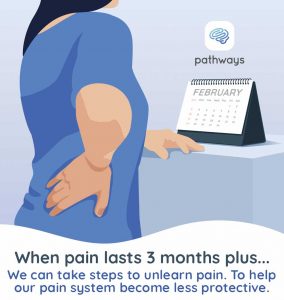
Stylized art of person holding their back. Pathways logo is over a calendar that says February. Type at bottom says: When pain lasts 3 months plus... You can take steps to unleran pain. To help our pain system become less protective.

Art provided by Pathways.

In addition, the app says, right up front, “Thoughts, feelings and beliefs can be enough to trigger debilitating pain.” However, the app is also very careful to point out that although the pain is in your head – because it’s caused by the brain – that it’s also very real and can be debilitating.

I have tried practically everything to feel better, so of course I was skeptical and even a little angry that an app claimed it could help me reduce my pain. But I wanted to try, especially since I was given the opportunity to do so.

When you download the app, which is available on the Apple App Store or Google Play, you first have to set up an account. (Note: it is not available on kindle.) All it requires is a name and email address, and then you can choose your diagnoses out of a long, very comprehensive list.

They say that they “tailor your program” based on the info you provide. Unfortunately, although there is a section called “Pain Diagnoses > Edit” in your profile, it doesn’t show the ones you’ve already chosen, or it didn’t save my list, I’m not sure which. You can add additional diagnoses, but if you’re like me, and can’t remember or see what you already submitted, it can be a little frustrating. (Also note: I am using the app on my iPhone 6S.)

The app starts with what they call a “consultation”, where they ask questions about your personal traits and life experience. Unfortunately, I don’t remember exactly what was asked, and once you go out of the consultations, you can’t go back. Supposedly, they also use these answers to help customize the sessions for you, but I have no way of knowing how true it is.

There are over 70 sessions narrated by Lisa, our “pain specialist”, and she has a very soothing voice that I like a lot. Besides claiming to be a way to literally change the neural pathways in your brain, the app is also like a path that leads you from one section to another, with new sessions “unlocking” as you complete some.

There is also a section they call “MeTime”, which includes almost 150 visualization and meditation sessions (I counted them, using excel!) in five categories: Relax, Wellbeing, Inspiration, Sounds, and Sleep. Quite a few of those sessions are also available before you pay for access to the app. (Note that not all of the sessions are narrated by Lisa. For instance, the “Pain Therapy Essentials” collection of five sessions is by Dr. Natalie Fienblatt. Although I adore her blue hair in her picture, I don’t really like her voice. Sorry, doctor.)

If there is a session that you particularly like, you can “favorite” it so you can easily find it again later. I have added the sessions “Sleep Relaxation”, “Recovery from Pain and Illness Meditation”, and “Relax and Heal from the Inside”, among others, to my favorites.

Many of the sessions mention research studies done on a variety of topics that ultimately led back to pain. The Pathways people cite a lot of sources, but they don’t make it easy for you to find them. They list some sources on their site, in a section called the Science Behind Pathways, but they don’t link to any of the actual studies they quote, nor even list the study name. I personally like to read the original source of studies (when my brain allows), so having to search them took extra time and caused me frustration.
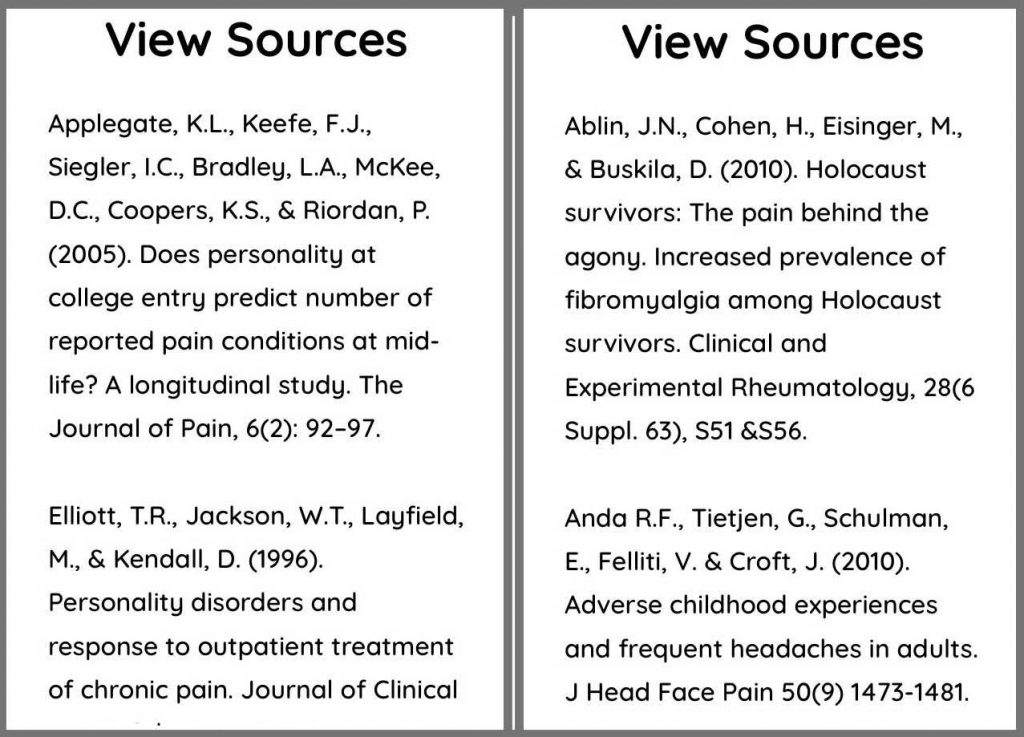
Two screenshots of Sources from the Consultation portion (first part) of the app. I could never figure out how to go back to them, and there were quite a few more sources listed. They don’t link out, either.

I would call Pathways a chronic-pain-therapist-in-an-app. The vast majority of the concepts they share aren’t new to me – though they could be to you – and feel very much like the many many therapy sessions I’ve attended. Only, ya know, without being able to ask questions and get answers.

Oh yeah, and guess what? Part of the Pathways program works on gratitude – so every day I wrote in my Gratitude Journal, I was not only improving my mental health, I was helping reduce my focus on my pain – or at least, distracting myself from it. (There are scientific research studies out there, which I can’t find at the moment, that say that practicing gratitude and mindfulness can improve your mental and physical health.)

My thoughts

Of course, ironically, writing about an app that is supposed to help reduce stress and pain is actually increasing both for me.
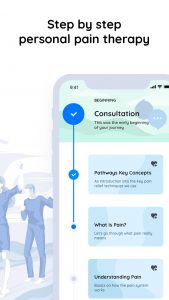
Art from Pathways. Headline says Step by Step personal pain therapy. There are four boxes. The first, a light green one, says Consulation. The second one is in light blue and says Key Concepts. The third, What is Pain? The final one says Understanding Pain.

Art provided by Pathways.

You can try 10 sessions for free before you hit the pay wall. The 10 sessions are full of stories of people who have used the app and supposedly gotten better, specifically in the sessions “Migraine Success Stories!”, “Fibromyalgia Success Stories”, and in others. Some people may be energized and reassured by these stories, but to me, they felt like a giant sales pitch, instead of true sessions to help with pain.

And I just couldn’t relate to those stories, because none of the situations they talked about were in any way what I deal with on a daily basis. (Well, minute-by-minute basis, actually.)

For instance, one lady discovered that her migraines were triggered by stress, and once she figured it out, she was able to not have migraines again.

This is great for her, but when you have chronic conditions, it’s not quite so easy. For instance, my migraines are triggered by weather changes, a fact I can’t do anything about.

Right now, I have a headache. Part of it is due to tension, because I am stressed about writing this post and the fact that I missed my deadline. (The other part is: I just live with a headache. Always.) I am tensing my shoulders and clenching my teeth. But by becoming aware of what I am doing, I can step away from the computer, take deep breaths, do some light stretches, jot a few notes, put ice on my neck, and tell myself positive affirmations, such as “I’m doing the best I can”, and it reduces the pain.

One of the concepts they share is that you have more and more pain because you are continually thinking about it, so those neural pathways become stronger and stronger.

As I mentioned, writing this blog post has greatly increased my pain, which just proves their theory that thinking about your pain makes it worse. Of course, that idea doesn’t take into account the effort required to sit at my computer, the movements I have to use to type and go back and forth between this page and others when I research, the strain on my eyes whilst looking at the screen, the pain caused by overuse of hands and arms to type, or the fact that sitting still for any length of time causes my muscles to seize up and produce lactic acid and get painful.

And that’s with my laptop on a stand so the screen is at eye level (to keep me from straining my neck down) and using an ergonomic keyboard while wearing my scoliosis brace, lumbar brace, having an ice pack underneath the lumbar brace, and wearing arthritis compression gloves! (The app suggested you shouldn’t use such things, as they believe it also causes more pain in the long run, but my pain would be far, far worse if I didn’t use them. Actually, I probably wouldn’t be able to write this post at all without them!)

In addition, the theory about pain increasing because you’re thinking about it all the time doesn’t completely ring true to me. I don’t actively think about pain unless the pain signals are screaming at me. For instance, I’ll often be going about my day when suddenly joints or nerves will start hurting. I’ll look at the time, and realize it’s way past when I should have taken my pain meds – I just didn’t think about it and forgot until my body reminded me.

They also suggest pushing through the pain. Again, this is helpful for some conditions, but definitely not for MEcfs. I firmly believe that my illness got so much worse, and I crashed so hard, because I kept pushing myself and working and ignoring my symptoms. Doing that made me become a full-time Sick Person. (Five years ago. How has it been FIVE YEARS?!??)

And, as another blogger said, “The focus on reducing coping mechanisms and pushing through is of no benefit when doing that can cause flares/more harm.

In fact, the only thing that has really made a difference to me is a concept called pacing. As quoted on the MEpedia page about Pacing, “First described by health psychologist Ellen Goudsmit in 1989,[1] it gives patients the advice to: “do as much as you can within your limits”.[2]

That means staying within my “energy envelope“, or the amount of energy I have in any given day. (Which changes. All the time.) It means listening to my body, resting way more than I think I should, and carefully deciding how to use my energy. Again, as mentioned many times, writing this blog post means I can’t do anything else. There is no doing this then doing another task, like laundry; I can do one or the other. It also means I’ve ignored all my social media and support groups and texts for the last few days; I just don’t have the mental bandwidth to do that too. (Sorry, everyone!)

But there are a lot of things that I found useful in the app. One of the concepts that really encouraged me was from a seven-minute visualization session (about 30 sessions in), called “Hurt does not equal Harm”. It reminds you that “pain is just a sensation”. It’s not easy to imagine “pain melting away and out of your body”, as it tells you to, but reminding myself that the pain doesn’t necessarily mean I’m getting worse has been a huge help.

I’ve also been using the “Sleep Relaxation” session every night to help with my chronic insomnia (as I mentioned, it’s one I favorited). Sometimes I have to listen to it two or three times before my mind shuts up enough to let me listen to one of my sleep playlists and actually drift off, but in general, I find it much more useful than other sleep meditations I’ve tried.

I personally had some issues listening to the sessions on trauma. I’ve done a lot of therapy work around the issues stemming from my trauma, but, if you are dealing with trauma and PTSD, you know it doesn’t just go away. I wasn’t able to get through those because they were just too triggering for me. (Maybe in the future…)

Another thing I want to point out about the app: sometimes, I (and other patients) have trouble with sound sensitivity, so I cannot always listen to the sessions. Thankfully, the sessions in the main program all have transcripts, so I can read them if I need to. (Or read them whilst listening to them.) The sessions in the MeTime do not have transcripts, which is a bit of a bummer. (Perhaps they can add those in an update of the app.)

One small annoyance about the sessions: The sound levels aren’t very consistent; I would have to increase or decrease the volume often when I’d go from one session to another. Also, when I’d switch to Pathways from listening to a music playlist, I’d have to increase the volume quite a lot to hear Lisa, and then the sound would blow my head off when I’d switch back to the music.

My recommendation

The app is not a cure for my pain, but it’s definitely a good tool to help me cope with it. If you suffer from chronic pain, I would definitely recommend getting the app and at least paying for one month to see how it works for you. If I had only listened to the free sessions, I probably would not have continued, but I’m glad I was given the use of the app and kept going through the program.

As stated earlier, you can download the app on the Apple App Store or Google Play. It costs $14.99 for a month’s access, $69.99 for a year’s access, or $299.99 for lifetime access. They also state on their website “If you don’t find hope for pain relief within 14 days, we’ll give you your money back”. I personally feel it’s worth the cost to at least try it for a month, especially considering all the things I’ve spent money on that didn’t help at all.

Again, access to the Pathways app for one year was gifted to me in exchange for featuring on my site. I never guarantee a positive review of gifted items, and all thoughts and opinions are my own. My thoughts and opinions on this app and pain are based on my years of dealing with pain – my whole life, really! – starting with TMJD and lockjaw as a kid, migraines, shoulder pain, and knee pain in high school, and all of the things I listed above.

Read more about it

Other chronic illness bloggers were also given the opportunity to try Pathways and talk about it and their own experiences with pain:


WEGO Health Awards

Last Friday (Sept 6), WEGO Health announced the list of finalists for the 2019 Health Awards. They had over 6,000 nominations, and after two rounds of judging, narrowed it down to 75 finalists.

Although I was not one of those finalists, I am very honored to have been nominated (truly!), and THANK YOU! to everyone who took the time to nominate or endorse me.

I’m also so pleased to say that two of my people are Finalists!

Fellow #MEep (person with ME) Brianne Benness of the chronic illness podcast No End In Sight is a Finalist in the Best In Show: Podcast category. Check out her profile on WEGO Health or her Twitter, which is where I discovered her. And, I literally just this second learned she has a cross-stitch company, Digital Artisanal, which is super cool even if I can’t cross-stitch anymore.

Jed Finley is a Finalist in the Best in Show: Twitter category. He has Ankylosing Spondylitis, a form of arthritis. I follow him on Twitter and you can also find more links on his WEGO profile.


Before you go:

I’ve never had ads on my blog, and never wanted them, but it’s expensive to have a website, what with the domain registration & hosting fees. And I haven’t been able to work in almost five years, and I get no disability benefits – and my medications and supplements cost me more than $300 a month!

If you found this post useful or inspiring, please consider supporting me and my ramblings:

  • with a $3 tip at ko-fi.com/dsavannah. Don’t forget you can set up a monthly tip, thanks to the person who gifted me Kofi Gold!
  • by donating via paypal
  • or sending me something from my Amazon wishlist.

Your support keeps me going, even in tough times. Thank you for stopping by my blog.

Oh! And I completely forgot to say THANK YOU! to the Faerie Goatmother, who so very kindly sent me two bars of her heavenly hand-made Lavender Oatmeal soap for my birthday! Check out her stuff! Oh, and she was my last featured person for The Questions – be sure to read all about her!

Also, if you would like to help terribly ill #MEcfs patients like me, please consider donating to the Open Medicine Foundation or SolveMECFSInitiative, both of whom focus on research and looking for a cure; or #MEActionNet, an organization that focuses on advocacy. Donate online with a credit card, giftcard, or paypal!

Posted in #dSavannahDefects, advocacy, chronicillness, community, disability, giving to others, hard work, health, illness, insomnia, learning, science | 9 Comments

I’ve Been Rambling for Seven Years!

Seven years ago today, I hit the “publish” button on my very first blog post, “Start at the Beginning“. This, my dear readers, is my 273rd published post.

I had a super hard time deciding how to “celebrate” this momentous day. I was gonna share my seven most popular blog posts, but there isn’t an easy way for me to figure it out on WordPress. (If you want to read some of my earlier posts, scroll all the way down to the bottom of this post, find the “More ramblings / other posts you might want to read…” section, and click on the photos.)

For my first blogaversary in 2013, I did seven days of posts and a trivia contest with 25 prizes collected from various writers and artists. Of course, I’m waaaayyy too tired to even consider doing that now.

So here’s what you get instead: a few lists of seven things.

Seven things that have changed since I started this blog:

(besides my entire life)

I no longer live in Arkansas. When I started this blog, I lived in the Ozarks of Arkansas, where I’d been since 2006, thanks to a job transfer for hubs. In December 2012, we moved back to Georgia. Instead of amazing sunsets (like in the photo) and the Milky Way at night, I see, well, mostly my four walls, since I can’t leave my bed most days, much less my house.

This was my view in Arkansas, right out my bedroom window. Just skies and trees. (Photo taken July 19, 2012.)

I became a full-time Sick Person. I became disabled.

I certainly never ever ever expected that to happen. I’ve worked since I was 10 years old. I paid my way through college. I paid my way through graduate school. Everything I have, everything I own, everything I was able to give to others, was the result of my hard work.

But I became sick, and sicker and sicker, until I finally had to admit I’m disabled. (Which by the way, is not a bad thing. It’s not a moral failing. About 20% of the population is disabled.)

My blog focus has changed. I always meant to use this blog as a place to talk about hard things and the Dark Places, like mental illness, to Shine a Light into them.

As I said in my Intro post on the topic way back in September of 2012, “I believe that part of my job here on this planet is to talk about these bad things. To shine light on those dark places, and illuminate them. If we can’t see them, we can’t fix them. If we see them, and turn a blind eye, we’re just as culpable.”

But primarily, I was gonna use this blog to promote myself as a writer, editor, artist, and marketer, and to promote other creators.

Now, I use my blog to advocate for chronic illness and all the other people like me.

My posts are also a lot lot lot longer. Most of the early ones were less than 400 words. Now they are more like 2,000 words. (This one is almost 3,000, and I’m not anywhere near being done!) (And you might wonder why I’ve become more verbose!? I guess because I don’t talk to humans very often these days!)

I’ve become a subject matter expert on many health conditions.

Y’all, I’m a hippy chick flower child artist. I never in a bajillion years thought I’d know words like ‘radiculophathy‘ and ‘stenosis‘ and ‘expressive dysphasia‘ and ‘inflammatory polyarthropathy‘ and ‘ataxic gait‘ and ‘occipital neuralgia‘ and ‘dorsalgia‘ and a whole bunch of other similar hard-to-pronounce words, and how they all relate to me personally. As in, those are ALL diagnoses I now possess.

I definitely didn’t think I’d know that the ICD code for Myalgic Encephalomyelitis (MEcfs) is G93.3, or for that matter, what ‘ICC code‘ even means.

I lost my careers. I can’t do any of the things I used to do that made me, well, me. The things that gave me my identity. I can’t take photos or paint or sing or teach or create or do marketing or edit or write (each blog post you read is the result of immense effort where I eke out a sentence here and a sentence there) or develop and maintain websites or develop relationships with media or raise money for nonprofits or volunteer for worthy causes or help people in need.

If I magically got well tomorrow, I doubt I’d be able to go back to my career as a marketing and public relations guru: so much time has passed, I have no idea what best practices are.

I no longer care what I look like. I don’t care about fashion or styles or regular social conventions anymore. When you can barely wash your hair, and at most once a week (more like every two weeks for me), you stop worrying about things like shaving your legs or wearing makeup or painting your nails or coloring your hair – so it’s a lot greyer than it used to be! (You also don’t have the funds for doing any of that. Cuz, doctor bills and medications.)

When textures can physically cause you pain, you don’t care what your clothes look like – you want them to be comfortable and functional. I now have a closet full of beautiful clothes and shoes I can’t wear. And I pretty much live in PJs now.

Time has lost all meaning. When you’re a working gal, you measure your life by bank holidays and vacations and big events.

Now? Not so much. I often have no idea what day it is, and wouldn’t know, except for my paper calendar and the date and time on my phone.

The other day, coming home from a doctor appointment, I saw kids get off the school bus and was utterly surprised and wondered why. Then I remembered: oh yeah, it’s August! When school starts! How in the heck did it become August 11 of the year 2019? How have I been full-time ill for almost five years now?!?

Seven things I’ve learned:

Yup, I’ve learned some hard lessons. Actually, a lot more than just seven, but to stick to the theme, I’ll just share seven, in no particular order.

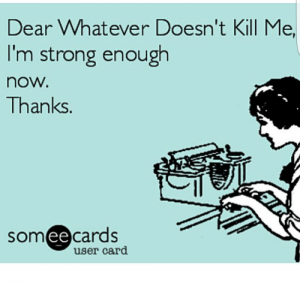
Dear whatever doesn't kill me, I'm strong enough now. Thanks.Progress, not perfection. Celebrate the small things.

This goes back to my April post “Just One Thing“. It’s okay if I can only write one sentence at a time, or only put away one dish, or fold one piece of clothing. I don’t have to do ALL THE THINGS, or get them ALL DONE RIGHT NOW, and they don’t have to be perfect. (My OCD often begs to differ, but I’m learning not to listen to it.) (Sorta.)

Every single thing I’m able to get done, no matter how small, is worth celebrating. Sent thank you notes to the people who donated to my Facebook fundraiser? Woot! Wrote and mailed thank you cards for gifts I received for my birthday! Yaass! Filed and logged a couple receipts from doctor appointments? Well done, me!

“Success” may look different these days than it used to, but it’s still worth being joyful about!

Some of the kindest, most understanding and supportive people are utter strangers.

I have been blown away by the people who have helped me as I became a Sick Person. People I’ve never met in real life. Who answered questions about various illnesses and treatments and shared resources. Who sent me funds via paypal or things off my wishlist. Who sent me messages saying that my words have helped them. Who have virtually held my hand as I’ve grieved over all I’ve lost. People who’ve cheered with me over small accomplishments and victories.

I’ve also been amazed at how many sick people are spending their precious energy advocating for more science and less stigma for so many disabling diseases. People who have applauded my efforts. People who have taken up the torch and kept going for and with me when I’ve been too tired to go on.

Some things just don’t matter. Not everything is important.

So, yeah. My baseboards are grimy. Furbunnies are multiplying under my furniture. The mirrors have streaks. There are dribbles on the trashcan in the kitchen. Towels and shirts aren’t neatly folded.

But none of that matters. And: it’s okay to watch Netflix. It’s okay to play a stupid game on my kindle. It’s okay to lay in bed wearing my noise-cancelling headphones and eye mask, if that’s what I need to do. Because what matters is taking care of myself, and then doing my best to take care of my husband and my fur-kids.

Listen to my body. Ration my energy.  I was always an overachiever. I always pushed myself to do more and be more and learn more. I pushed myself until my body broke.

I never really paid attention to my body – it was just the vehicle that allowed me to do all the things.

Now, I’ve learned (okay, am learning) that if my body says I need to rest, I rest. If I need to eat, I eat. And remind myself over and over, see #3!

Being kind to myself was probably the best thing I could have done, and still do, tho it’s hard sometimes.

Tolerating my disease is not giving up. I fought and fought and fought to find out what was wrong with me. I refused to accept that I was ill and wasn’t going to get better.

Until, I finally did.

Part of that was a lot of therapy, and a lot of reading other blogs written by people with chronic illness, and talking with other patients.

What really helped was taking the pressure off myself to be what I had been before and to do what I did before. To stop judging myself.

I learned to tolerate and live with my disease, instead of battling it.

I matter. I’m worthwhile.

Before the onset of ME, I used my ambition and hard work to prove my worth. When I got sick, I felt like the universe was playing a cruel joke—I felt worthless before, when I could do so sooo much more, and here was this illness saying, “Now you don’t get to do any of it. I’m taking away everything that makes you, you. I’m taking away everything that you consider makes you worthwhile. Now how do you feel?”

By the way, that above paragraph? Words I said. Because I have MEcfs, I was able to be a research participant for a graduate student. My words and experiences helped her with her thesis, Patient Narratives of Myalgic Encephalomyelitis: Situated Knowledge for Re/Constructing Healthcare, and hopefully, will help future medical students learn to be better listeners as doctors.

Because of my illnesses, I’m also a research subject for symptom reporting for Arthritis Power by CreakyJoints, a research initiative in conjunction with rheumatology researchers at the University of Alabama at Birmingham.

Oh, and if you have arthritis or fibromyalgia or similar conditions, you too can participate in Arthritis Power and help researchers understand these diseases. For instance, here’s a medical research paper published in the exciting sounding journal Annals of the Rheumatic Diseases: Barriers to rheumatoid arthritis treatment optimisation: real-world data from the arthritispower registry.

See? My – YOUR – experiences matter.

I can’t do much, but I can be kind. The header image for all of my social media is one of my photos with the quote “Everyone you meet is fighting a battle you know nothing about. Be Kind. Always.”

And I mean that, and I try to live by it.

As I said to the graduate student, and was quoted in the aforementioned graduate thesis, “I can be kind. I can be on my support group and someone says, ‘I’m having a really shitty day’, and I could say, ‘okay talk to me’. I can listen. And I feel like what’s missing a lot in our society is the feeling that bearing witness is worthwhile. So, when I’m talking to someone … I’m bearing witness and I’m helping them carry that burden.”

Our society seems to value money and things and accomplishments and awards over kindness, but kindness is what we need most.

Seven Three people who read my blog and why:

I asked about 14 readers and friends if they wouldn’t mind giving me a quote for this blog post, but because I only thought of it on Wednesday, I only heard back from three of them. So here’s what they said, in their very own words (and in the order in which I received them):

“Why do I read? Because, you endure ME. And, as a friend, I want to learn more about what you have to endure, and ways I can better support you, and others fighting ME. You are very active in putting information about ME on your blog. It’s helped me better understand how ME affects you, and others who have it. Now, I monitor science and technology news to learn more about ME, and its causes, so I can be a better friend.

“You are not missing to me. Never have been. Never will be.”

~ He said: “Call me Mark. As always. 🙂.” Mark is a computer tech and flash fiction writer, whose words you can find on his blog at My Souls Tears.

~Liz, an ME/CFS patient for 28 years, who serves as the #MEAction Georgia state advocate, which you can find on facebook, twitter, and instagram, wrote:

“I met DSavannah at a screening of Unrest in Atlanta. We had both struggled to get to the theater but we were happy to be there, in public, out in the world. I don’t think either of us had the strength to stay until the end of the movie. That’s ME/CFS.

“In her blog, DSavannah discusses the messy, burdensome truths of living with chronic illness. She tackles the stigma and shame and guilt that all people with chronic illness experience. Then she goes further and suggests that we all give ourselves a collective break. To hell with the stigma, she seems to say, Look at what I CAN do!

“As a long-term patient with ME/CFS, I feel the shame of not being able to somehow heal myself. DSavannah seems to relate to this, and she refuses to apologize. She speaks boldly from her bed.

“I used to find her words empowering. Today it is more. To demonstrate courage in the face of disabling illness is absolutely essential. I read her blog and laugh (THANK YOU!). I read her blog and think, Okay I can do this.

“Congratulations on 7 years of writing! That’s truly something to be proud of.”

(dSavannah note: As you can imagine, such kind words made me cry. And those sentiments are why I keep doing this. I know I’m helping myself by expressing what I’m feeling and experiencing, but I’m also helping others.)

~a pwME who has been sick for 20 years, who allowed me to link these sites – Patient-XX40, Invisibly Ill, and Inspiration Domination – but asked not to be named, wrote:

“Initially, I was compelled to read D. Savannah’s blog because I knew she is a warm, engaging, compassionate, intelligent, driven woman who has multiple interests in common with me. I continued to read because she continues to pour her lifeblood into each and every post. And because each and every post in some way has to do with me, M.E. (Myalgic Encephalomyelitis) and everyone else with M.E.”

So there you have it. Three people telling it like it is. 🙂

Seven things I plan to do in the future with my blog:

Oh, who am I kidding? I have no freaking idea.

For a while now, I’ve wanted to rework The Questions so I can have chronic illness bloggers and advocates answer them, and go back to featuring guests in that way, but I just haven’t had the energy/strength/time/brainpower to work on it. But, hopefully sooner rather than later. People seemed to really enjoy the interviews, both the respondees and my readers.

Of course, I hope to continue my goal of posting once a month, not just for 2019, but from here on out. And maybe even twice a month in 2020. (I don’t think I’ll be publishing a post on the 15th of this month, tho I had originally planned on it. I’m just too knackered.)

Thanks to everyone who hangs out with me, and reads my words. Happy Seventh Anniversary to my Ramblings! Sláinte!


THANK YOU! to everyone who endorsed me for the WEGO Health Award. As I mentioned in the post Help Me Help Others!, I was nominated in three categories: Best in Show: Blog, Best in Show: Facebook, and Best Kept Secret. I don’t know how many votes I ended up getting, but last I checked before the nominations closed, I was at 120 or so. I am so honored that I was nominated, and that people took the time to endorse me. Again, I doubt sincerely I’ll win out of the “over 6.5k nominations and over 130k endorsements” they received this year, but I am hopeful it will lead more people to my blog, and thus, allow me to help more people who need it.

Another big THANK YOU! to the friend/reader who sent me a bottle of Vitamin D off my wishlist for my birthday last month – because she knows how important Vitamin D is to her health, and thus to mine. And a thank you to the person I don’t even know – we connected on twitter – who sent me ink for my printer! As they wrote in their message, “when I saw the toner need on your list, I was like, yep that’s the one. You need those records! So vital for progress in our journeys.

Don’t forget that there’s still time to donate to Alice’s gofundme for an essential electric wheelchair. (I featured her last month in the post #MEcfs Awareness: Guest Post “Send My Apologies”.) She still needs over £850! Please donate if you can, and definitely share!

THANK YOU! to everyone who donated last month to my birthday fundraiser on Facebook for #MEAction. We raised $656 for their vital efforts.

I’m sorry I haven’t been able to record my blog posts for those who have a hard time with reading. I lost my voice for a total of 62 days!!! after trying – and failing – to go my state’s #MillionsMissing event on May 11 – because my GERD (acid reflux) is back and it inflamed my vocal cords after a bad crash. I thought my GERD was gone for good after having Nissen fundoplication surgery to correct it in 2010, after having had it my whole life.

So I’m having to take meds again for GERD, I’m going to speech therapy every two weeks, and I have to rest my voice as much as possible.

To add insult to well, injury, the meds dry my eyes out something fierce, so they feel like burning little cinders, and I’m having difficulty getting the eye drops I need to help with that, thanks to insurance.

I ain’t kidding when I say chronic illness is a full-time job. It’s the WORST.

Note: the birthday balloons, confetti, cake, etc. art that I used in this post is from the Birthday Badges collection on Designed by Freepik, which is free as long as I include this wording and a link. I re-worked it all to match my colors and how I wanted everything to look (pack name: pack-pegatinas-cumpleanos-colores-estilo-retro).

I’m thrilled I could remember how to change the colors (in Illustrator) and make my own layout (in Photoshop), something I wasn’t sure I’d ever be able to do again… even if I’m super slow and probably not doing it correctly, and it’s not as perfect as I want it to look.

Actually, creating the art came easier than writing the words for this post. Go figure. Our brains are weird, y’all.


Before you go:

I’ve never had ads on my blog, and never wanted them, but it’s expensive to have a website, what with the domain registration & hosting fees. And I haven’t been able to work in almost five years, and I get no disability benefits – and my medications and supplements cost me more than $300 a month!

If you found this post useful or inspiring, please consider supporting me and my ramblings:

  • with a $3 tip at ko-fi.com/dsavannah. Don’t forget you can set up a monthly tip, thanks to the person who gifted me Kofi Gold!
  • by donating via paypal
  • or sending me something from my Amazon wishlist.

Your support keeps me going, even in tough times. Thank you for stopping by my blog.

Also, if you would like to help terribly ill #MEcfs patients like me, please consider donating to the Open Medicine Foundation or SolveMECFSInitiative, both of whom focus on research and looking for a cure; or #MEActionNet, an organization that focuses on advocacy. Donate online with a credit card, giftcard, or paypal!

Posted in advocacy, art, birthdays, community, friends, giving to others, hard work, health, illness, inspiration, making a difference, perseverance, shining a light | 13 Comments

#MEAwareness: Guest Post “Send My Apologies”

dSavannah note: I’d like to introduce y’all to my friend Alice Ballinger, a #ChronicIllnessWarrior and poet, who publishes her work on Facebook on her Green Goat Poetry page, and who is raising funds for a desperately needed wheelchair. (Also, please note that in my state of tiredness, eyes burning, back hurting, and anxiety, I published this post before it was ready, so subscribers have received an unfinished post in their email! I changed the status to draft, but I have no idea if that means it will email it again when I hit publish on purpose… Oh botheration… And I think I messed it up even more, so I completely deleted that post and created this one… So if you try to comment on that one, you’ll just get an error. Sorry!)

It’s Monday the 15th, which means it’s time to publish this post. However, I am having a very hard time writing this intro, even though I’ve been trying to work on this for weeks! I want y’all to understand how lovely and special Alice is, and what a dear person she is, but words are failing me. So, here’s what I have:

The Hope Plant on 07.09.2019. The baby leaf unfurling looks like a heart to me.

Alice and I initially connected three years ago on Facebook over our shared love of Terry Pratchett‘s Discworld, the fabulous book series about a world not unlike our own, only it is a flat planet balanced on the backs of four elephants, and they perch on a world-turtle, The Great A’Tuin. (Sir Terry being one of my Very Favorite Authors, who of course I’ve written about before on this blog.)

Then, turns out that Alice, too, is chronically ill and disabled. I can thank Alice for helping me figure out some of my diagnoses – because we share so many symptoms! If it weren’t for her, I wouldn’t have gotten diagnosed with hypermobility syndrome, because I wouldn’t have known that the sum of some of my symptoms equaled a subset of Ehlers-Danlos syndrome, one of the diseases she has (only hers is much worse than mine).

Although the #MillionsMissing hashtag was coined by #MEAction, and is a big part of their / our advocacy, Alice pointed out in this poem that not just people with Myalgic Encephalomyelitis (MEcfs) are missing from having vibrant lives: many other people who have disabilities, both visible and invisible, are hidden from the world.

Sadly, Alice is one of the missing people.

I am sharing her poem for a couple reasons. One, it ties in with my own advocacy around chronic illness, and two, she wrote it for me. (I’ve written poems for lots of people, but I don’t think anyone has written one for me.) Obviously, I feel it should be shared with the world, as it perfectly captures the loneliness and isolation felt by many of us who are ill, and many of the barriers we face to being part of the world.

Most importantly, tho, I want to help Alice. She desperately needs a wheelchair. Although she was told eight years ago that she should probably get a wheelchair, she stubbornly tried to retain her mobility by using a rollator instead.

And of course, using a rollator (which, for those who don’t know, is like a walker, but with wheels and a seat, for when you need to rest, and is the type of mobility aid I currently use) has damaged her shoulder, and made her hips and back worse!

She has set up a gofundme page to raise money to purchase an electric wheelchair that will suit her needs and allow her to go to the park, around town, to her doctor’s offices, the store, and wherever else she wants or needs to go. She needs to raise £1,999 (or $2,500 US!) to get a power wheelchair that will be durable and usable. So far, she has £810, or approximately 40%.

She’s also sold some of her belongings at a car boot sale, and is doing everything else she can to raise the funds.

So, if you can, please donate and help her, and if you can’t, please share her gofundme page and this post with her poem. (And I hope I’ve done Alice and her poem justice.)


Send my apologies

Send my apologies
It’s too far for me
Can’t use the stair
I’ve no money anyway
It’s not fair

Send my apologies
It’s too early you see
No, that is too late
The queues are too long
I can’t stand and wait

Send my apologies
I’m far too tired
Too much in pain
I feel so sick
I know, again

Send my apologies
I’m too scared to go
I cannot cope
But maybe next time
We can hope

Send my apologies
Go have some fun
I’ll just lie down
Closing tight my eyes
Holding back a frown

Send my apologies
I’ll send a text
I’ll write a letter
Look forward to seeing you
When I feel better

Send my apologies
I send a kiss
In my lonely bed
Missing
To the millions I miss

©Green Goat Poetry, 14th May 2019
For all those missing due to illness, disability, and mental illness

Dedicated to my dear friend DS George-Jones
For the #MillionsMissing campaign

With love, from one missing person to another

dSavannah note: For those who have difficulty reading, Alice made a video of herself reading the poem, which you can find on her Green Goat Poetry Facebook page. (Written version originally posted here.)


About Alice:

Alice lives in Malton, North Yorkshire, across the pond from me in the United Kingdom.
She has Ehlers-Danlos syndrome, spinal stenosis, and muscular atrophy, among other health conditions.

She loves animals – her ‘birbs’ are Zebra Finches and canaries, and her dog, Boogles, a Boston X chihuahua, is her emotional support animal and best friend.

In addition to being a poet, she used to be a chef and then oddly…a data analyst. She used to enjoy the outdoors life but it’s very much diminished by her disability.

Recently divorced and struggling with bereavement and deep-set trauma, she’s trying to rebuild a life for herself. Donating to her gofundme will help make a big difference in her quality and enjoyment of life.

Find Alice:


Before you go:

If you found this post useful or inspiring, please consider supporting me and my ramblings:

Your support keeps me going, even in tough times. Thank you for stopping by my blog.

Posted in #MEcfsAwareness, advocacy, chronicillness, community, disability, friends, giving to others, health, illness, making a difference, mental illness, poetry, shining a light, writershelpingwriters | 2 Comments

Help Me Help Others!

Image with sparkles and a gold trophy on the left. Endorsements now open is written in a blue banner. The WEGO Health Awards logo is next to the tropy.

Click this photo to go straight to my profile and endorse me!

Dear readers, no, your eyes do not deceive you. It’s not the 15th, the day I promised to publish a blog post every month this year. It’s the 5th! (I actually meant to publish this on Monday the 1st, but I’ve been too brain fogged and exhausted and poorly to do so. I’m embarrassed at how many drafts this little post has required; I keep messing stuff up and have to go back and fix it! So if half this post is nonsense, please forgive me and my current, giant headache.)

I’m publishing early because, tada! The three WEGO award logos for Best in Show: Blog, Best in Show: Facebook, and Best Kept SecretI’m honored to say I’ve been nominated for ✵three✵ WEGO Health Awards: Best in Show: Blog, Best in Show: Facebook, and Best Kept Secret. That means someone (I’m not sure who, but thank you!) thinks I’m a #PatientLeader who is “making a difference in the online health community”!

So here’s where you come in: Simply click the link (or one of the images), scroll down to the orange “endorse dSavannah” button (under my photo), chose one of the three categories, and click the orange “nominate now” button. It’s that simple! And, I have been reliably informed that you can endorse me for all three categories. (Endorsements are open until July 28.)

As the WEGO people put it: “Think of it as a way to give a shout-out or virtual hug to your favorite Patient Leaders.” (In this case, yours truly! And I’m grateful to every single person who takes the time to do so.)

How does this help me help others? Well, by endorsing me, and then sharing that you’ve done so, I hope this will help other patients find my blog, and that way my words and my advocacy will help even more people! (Did I use the word “help” enough in this paragraph? 😉 )

If you’re wondering who in the heck is WEGO health, according to their about page, “WEGO Health is a mission-driven company connecting healthcare with the experience, skills and insights of Patient Leaders.” This blog post explains How The WEGO Health Awards Work, a “program created to recognize and honor those making a difference in the online health community.”

FYI, “the endorsement process helps select top Patient Leaders to move on to the finalist round. The three most endorsed nominees in each WEGO Health Award category will automatically become a finalist.”

Now, I don’t expect I’ll be one of the top three most endorsed nominees in any category (in 2018, they received over 4,000 nominations!), but I certainly appreciate the shout-outs and support!

You can also endorse other advocates I follow who have been nominated:

  • Charis Hill, of Being Charis Blog, who I nominated and have mentioned on this blog quite a bit (and am a bit embarrassed by what I wrote; as I’m new to this, I didn’t realize they’d actually post my nomination reason for all to see!): endorse here
  • Jo Moss from Journey Through The Fog, who writes about ME, fibro, mental health, and the like: endorse here
  • Char of Chronically Hopeful, who uses her blog to “raise awareness of invisible chronic illness”; she also made 360!!! personal #MillionsMissing posters for other patients this year!: endorse here

Before you go:

Facebook fundraiser art of people adding hearts to a thermometer


Please donate to my Facebook fundraiser for my birthday, benefiting #MEAction!

This year for my birthday (7/11!), I’m asking for donations on Facebook for MEAction. Money spent on advocacy gives a great return on investment for research dollars: a 25 to 1 ratio of research dollars for advocacy dollars invested in disease-specific efforts! You can participate by donating on Facebook, or directly on the #MEActionNet website.

If you found this post useful or inspiring, please consider supporting me and my ramblings:

Your support keeps me going, even in tough times. Thank you for stopping by my blog.

Posted in #dSavannahDefects, advocacy, chronicillness, community, giving to others, health, illness, making a difference, mental illness, opportunity | 4 Comments