
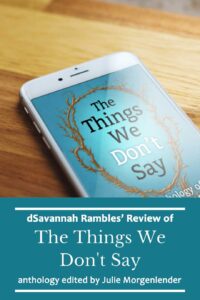
 Sometime back in ye olden days of March or April, Julie Morgenlender, a member of my Chronic Illness Bloggers group, posted a request for reviewers for her upcoming anthology, The Things We Don’t Say: An Anthology of Chronic Illness Truths.
At first I said no, because brain fog and also, I’m behind on my reviews by at least 10 books. But somehow, she convinced me because a) I’m a sucker for ARCs (Advanced Reader Copies, or, a book that hasn’t yet finished the publication process, and is just available for review) and b) of course the book is the perfect fit for my blog, what with wanting to Shine a Light into the Hard Places, and also my focus on chronic illnesses since I have a collection of my own. Also, I should add c) she understood if I couldn’t publish the review right away, and was okay with giving me a longer deadline.
I prefer paper books, as I like to be able to put post-it tabs in the book, and write my thoughts on sticky notes I’ve put in the front, but I soldiered thru reading the e-ARC on my kindle, and wrote my notes in a little notebook I kept beside me as I read (see photo below).
And, because I just can’t help myself, I also noted typos I found in the book, and when I was done reading, I typed them all up in the PDF of the eBook, and sent them to the Julie – because it’s basically impossible to edit your own work. Your brain fills in the missing information. And it’s impossible for me to shut off my editing brain. And she didn’t mind me sharing them. (FYI – if you find typos in my work, please please tell me! so I can fix them!)
I started reading the anthology on May 8, wrote myself 10 pages of notes and typos, and finished reading on May 28. Which is waaay faster than I expected! Of course, then I managed to not write the review until now (August!) due to… well, life… But I’m totally proud of myself that this blog post was actually 96% ready two days ago, and today (August 15), all I had to do was proofread one last time and hit publish, as opposed to frantically typing up my thoughts and publishing a few days late.
Anywho, here you go: information on the anthology and the long version of my review of The Things We Don’t Say: An Anthology of Chronic Illness Truths [affiliate link] – this is opposed to my short review, which simply says “me likey”.
About the anthology:
This anthology has 50 essays written by 42 authors from all over the world, including two by the editor. The authors have a variety of illnesses.
This book is a true labor of love. Julie Morgenlender served as the editor and curator of the book, and she released it into the world on July 1, 2020 – after six years of working on it. She told me in an email “I actually expected to publish in 2018. When that didn’t happen, I knew without a doubt that I would publish in 2019. And now we’re halfway through 2020.”
The book is divided into seven parts, with as few as five essays and as many as nine per section. Some essays are as short as two pages. Because most of them are so short, it seems quite easy to read them, even on high brain-fog days. I was honestly surprised at how quickly I was able to read the entire book. Everything flowed so beautifully; even tho you can easily stop reading after just one essay, I didn’t find it confusing at all to read several in a row.
At the end of each essay, you’ll find a photo and short bio of the author. This is nice, except in the case of a couple authors who have more than one essay in the book, like Glynis Scrivens, who has three. I got confused because I was pretty sure I’d seen her bio before, but not 100% certain, because brain fog.
The editor includes the location of the author under their name with the essay title, which helps orient you, as every country has slightly different protocols for treating illnesses.
I quite like the design of the cover and interior.
Julie is clearly an over-achiever and perfectionist, just like I am. She has provided two resources on her site related to the book: an index, so it’s easier to find what you’re looking for in the book, and a glossary with definitions of many of the diagnoses, symptoms, treatments, and more.
You can also read a short bio of each author on the site.
My Review
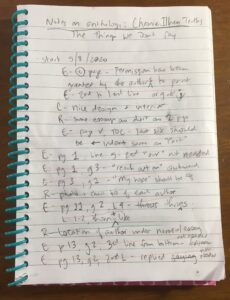
Don’t bother trying to read these notes I took for my review. It’ll just make your head hurt. My handwriting is awful!
dSavannah note: Not all of the authors in the anthology have websites or a social media presence, and some wrote their stories under a pseudonym, so I can’t link to all of the writers I mention specifically.
All chronic illnesses are not the same. Even people with the exact same diagnosis might have wildly different symptoms from each other, and respond differently to the same treatment. This book’s range and diversity point out this important message.
Overall, the anthology is easy to read, short and to the point, and unashamed about the truths it reveals about chronic illness – things that many people with chronic illness feel unable to share and admit about their lives.
The 50 essays share the whole gamut of negative emotions you feel when you have a chronic illness: grief, shame, guilt, sadness, etc. Many of the essays are so passionately written, you can almost see the sweat from the writer on the words.
It will also make you angry when you read how many times those with chronic illness have their symptoms and physical issues ignored and dismissed, as especially pointed out in the essay by Julie Morgenlender, the editor, “My Journey for Answers: Because No One Will Care More about My Health Than Me”.
Some of the essays include tips for dealing with chronic illness, such as the essay “Things Every Newly Diagnosed Patient Needs to Know” by Dylan Gomez, who writes “Don’t ever let anyone tell you that your pain isn’t real or is all in your head. You don’t have to prove your pain to anyone for it to be real.” and “You don’t have to inspire other people, set an example, or find a lesson in this.”
I’m not sure I would have opened up the book with two essays about sex – I absolutely agree that we need to get rid of the stigma around it, especially for people with disabilities – but I wonder if it might stop people from reading the rest of the book. (But please don’t let it stop you!)
“This Is Hard”, by the editor, the eighth essay in the book, really sums up how I feel about my chronic illnesses and how they have impacted my life. It includes the sentences “Living with chronic illnesses is hard.”, “Hearing platitudes is hard.”, and “chronic illness guilt is so much harder.” (that last one? I copied into my notes, because it’s so true).
I noted that I could have written at least the first few pages of the essay “I Didn’t Cry on My Birthday This Year” by Tara A., who, like me, suffers from MEcfs and fibromyalgia. I can’t decide on just one sentence to quote; they all resonate with me so much, from the changes my illness has forced upon me to how I often feel alone and how much I have to limit what I do.
I also really loved the sentence: “There’s this dichotomy about illness, a dangerous one that exists in our society, where you are either 100 percent well or 100 percent sick, and if you’re sick, then you stay out of view until you’re 100 percent well again”, from Keidra Chaney’s essay “I Am Not My Cornea”.
And: “If I’m a survivor, why do I feel small and insignificant every day? Why do I feel like my life before me, my future, is like a black cloud in the distance waiting to burst over my head?” from “An Echo Unheard” by Deepti Dilip Kumar.
I particularly loved the essay by Heron Greenesmith, “Pain”. I even felt the urge to contact them via twitter right after I finished reading it and wrote: “your essay is amazing and relatable and so well written.” This line especially was meaningful to me, considering how much I fought and searched for a diagnosis for my own issues: “A diagnosis is, like any label, a privilege granted by the labeler. Labels carry power and control.”
Other stand-out essays include Amy Oestreicher’s “PTSD: The Illness I Couldn’t See”; “What Is It Like?” by Hannah Rembrandt; and “I Wish I’d Known” by Zoe A. Bateman.
The most important bit of my review:
If you have chronic illness(es), reading these essays will make you feel seen and no longer alone. If you have a friend or loved one with chronic illness, reading these essays will help you clearly understand what they are going thru and how hard it is, especially if they don’t talk to you much about their conditions. If you are a health care provider, reading these essays will help you gain empathy for your patients and perhaps teach you some things as well.
Note: As stated above, I received a digital ARC of this book from the anthology. This has no bearing on my review. I never guarantee a positive rating, and all thoughts and opinions are my own.
If you don’t take my word for why you should read this, here are some reviews by other chronic illness bloggers; it was interesting to me how different parts of the book resonated with the different bloggers:
- Getting Closer to Myself
- Notebooks and Glasses
- The Comical Colon
- Tales of a Natural Spoonie
- Brainless Blogger
- Colitis to Ostomy
You can also read a bunch of reviews Julie has posted on the book website, as well as the short(er) reviews I posted on Amazon US, Amazon UK, and Goodreads.
About the editor:
J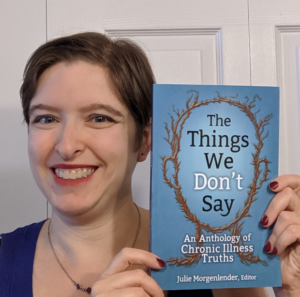 ulie Morgenlender is a friend, daughter, aunt, crocheter, reader, creator of this anthology, and so much more, despite being unable to work full time.
She enjoys walking in the sunshine, petting dogs, and spending time with awesome people. She volunteers for her chronic pain support group and is on the board of directors of the Bisexual Resource Center.
For more info, check out the About the Editor page on the book’s website.
Find Julie and Chronic Illness Truths:
- Book Website
- Links to the recording and transcript from the book launch party (June 28, 2020)
- Order a signed bookplate for your print edition
- YouTube
- Tumblr
- Goodreads – the book
- Goodreads – the editor
- The Celiac Project Podcast; Julie was a guest for the July 1, 2020 episode
Buy the book on Amazon US [affiliate link], Amazon UK, Amazon Canada, and Amazon Australia. It’s available for Kindle (both for purchase and via kindle unlimited) and in paperback.
If you are unable to get the book from your country’s Amazon site, please let Julie know via this form, which will help her know where to focus her efforts on International distribution.
Julie is working on an audiobook version for those who have trouble with reading.
PS: If you enjoyed or appreciated what you read, and aren’t currently a subscriber, then please follow my blog! Simply enter your email address in the box under “Follow dSavannah Rambles” that’s on top of the right-hand column. (Or, if on mobile, scroll aaallll the way down to the bottom of the page and enter your email address in the subscribe box.) Thanks!
Before you go:
If you found this post useful or inspiring, please consider supporting me and my ramblings:
- with a $3 tip at ko-fi.com/dsavannah. Occasionally I post photos there that I don’t post anywhere else.
- or sending me something from my Amazon wishlist (now conveniently separated into categories: dSavannah’s health needs, Books by Other Spoonies (NEW!), Miscellaneous stuff., books for my hoard!, low priority: crafty stuff, and music I’d like).
You can also help me by clicking my affiliate links – As an Amazon Associate [affiliate link] I earn from qualifying purchases. This means if you click a link, and buy something (not necessarily even something I’ve linked to), I supposedly get a wee percentage of the sale. Doesn’t cost you anything, and helps me support my taking medication habit. (Note: links to my wishlist do not count, for whatever reason!)
I am also an affiliate for my web hoster, Lyrical Host. If you switch your site (which was soooo easy, even for brain-fogged me!) to them, or decide to start one, just use the code “dsblog10” at checkout and get 10% off your first hosting plan payment! It’s a win for all of us!
Your support keeps me going, even in tough times. Thank you for stopping by my blog.
Also, if you would like to help terribly ill #MEcfs patients like me, please consider a tax-deductible donation to research organizations that are looking for a biomarker and a cure: Open Medicine Foundation, SolveMECFSInitiative, and the new The Morten Group at Oxford University (which I swear I will be sharing about soon!); or #MEActionNet, an organization that focuses on advocacy. Donate online with a credit card, giftcard, or paypal!








Thanks for the review. I will definitely check out this collection!
Thanks for stopping by! <3
Sounds like an excellent collection. The comment that “hearing platitudes is hard” really hit home! We can all relate to that. Sometimes when we hear “things could be worse”, I want to scream “But they could be better!”
There are many times I want to scream something similar! Thanks for stopping by and reading!