

Not me. My grandmother. But also, a girl.
In case my dear readers haven’t noticed, I’m a girl.
I was born a girl, I’ll die a girl. (Sans some parts, cuz, well, some of them were bad.)
I’m also a feminist, which means I believe in equality for the sexes. And, as I’ve written about before, I’ve suffered abuse because I’m a girl. And sexual harassment. And mistreatment in the workplace because I’m a girl. And I’m afraid of many, many things that men cannot even fathom, because they are men and I’m a girl.
Which leads me to this book, What Girls Are Made Of, which launches today.
I first encountered this author’s work when I was able to request her children’s book Far From Fair from Amazon Vine (the super-secret group on Amazon I get to review for).
Which I loved. (These days, thanks to my stupid brain fog caused by my stupid #InvisibleIllnesses, I find myself mostly reading YA and children’s books – they are short, they are compact, they don’t get bogged down in “adult themes” – essentially, my stupid brain can concentrate enough to read and enjoy and understand them.)
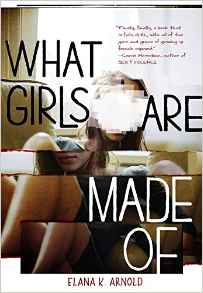 Anywho, when a request went out for reviewers for Elana K. Arnold’s new book via NetGalley (back in November 2016), I jumped on requesting the ARC of What Girls Are Made Of, not even knowing what this title was about, or that it was for older audiences.
I certainly didn’t expect the depth of the story, and how far the author would take us in the narrator’s journey of being, well, a girl. A teenage high school girl, in fact.
I was grabbed by the descriptions in the first paragraph of this book, and saw the narrator, Nina, and her mother, in the simple but important dance that all women do: fold sheets.
And then I could not put the book down. I read, and read, and read, until I was finished reading. Which is HUGE for me, because as I said, I have a hard time concentrating these days (thanks, Sick Person Body and #InvisibleIllnesses).
The book is sad, and lonely, and perfectly describes the confusion that girls feel. The longing for someone to love you unconditionally, the longing for someone in particular, the hurt when it doesn’t work out. The embarrassment of having a woman’s body: the periods (and how disgusting they are), the small breasts, the shoes, the desire to look slutty while not being a slut, etc.
The book weaves together short “stories” that were supposedly written by Nina for a class project, and her past and present experience with love: family love, friend love, boyfriend love. The stories focus on female saints who were mutilated – a poignant look at women who were adored and then reviled.
The book deals unflinchingly with some tough issues: abortion, teenage sex, death, parents who aren’t really there, etc. But I hope lots of girls read this book, and realize they are not alone in how they feel.
I admire the author for channeling her anger at being a girl (and love; we can’t imagine being anything else) into this work.
A lot of people will probably hate this book and Nina’s choices. They won’t agree with her decisions. They may revile the author for even writing about these things, and so candidly.
But, I honor her because she did. And I truly hope that it reaches girls who need it.
And even if you don’t “need” it yourself, please read it anyway. And then give a copy of it to someone who does.







Sounds like a great book! Thanks for telling me about it. Maybe on payday 🙂 @mirymom1 from
Balancing Act
You’re more than welcome, of course! 🙂
these brain fogs sure can be annoying, aye? 😀
Joy @ The Joyous Living
Annoying, frustrating, infuriating, etc… So. Very!
It sounds quite confrontational – and sometimes it’s good to read something like this so we step out of our comfort zone. Just so you know, I love YA Fiction – there’s some terrific books written in this genre (especially the fantasy series authors)
I think my review is more confrontational than the book – the book is rather matter-of-fact in telling what Nina experiences.
Yes, there are many great YA fiction stories. 🙂 Any that particularly resonate with you? I recently read and loved See You in the Cosmos by Jack Cheng, and The Year of Shadows by Claire Legrand.
Excellent review.
Thanks, dear!